Circular Economy in Construction: From Existing Buildings to Resources
24. August 2026
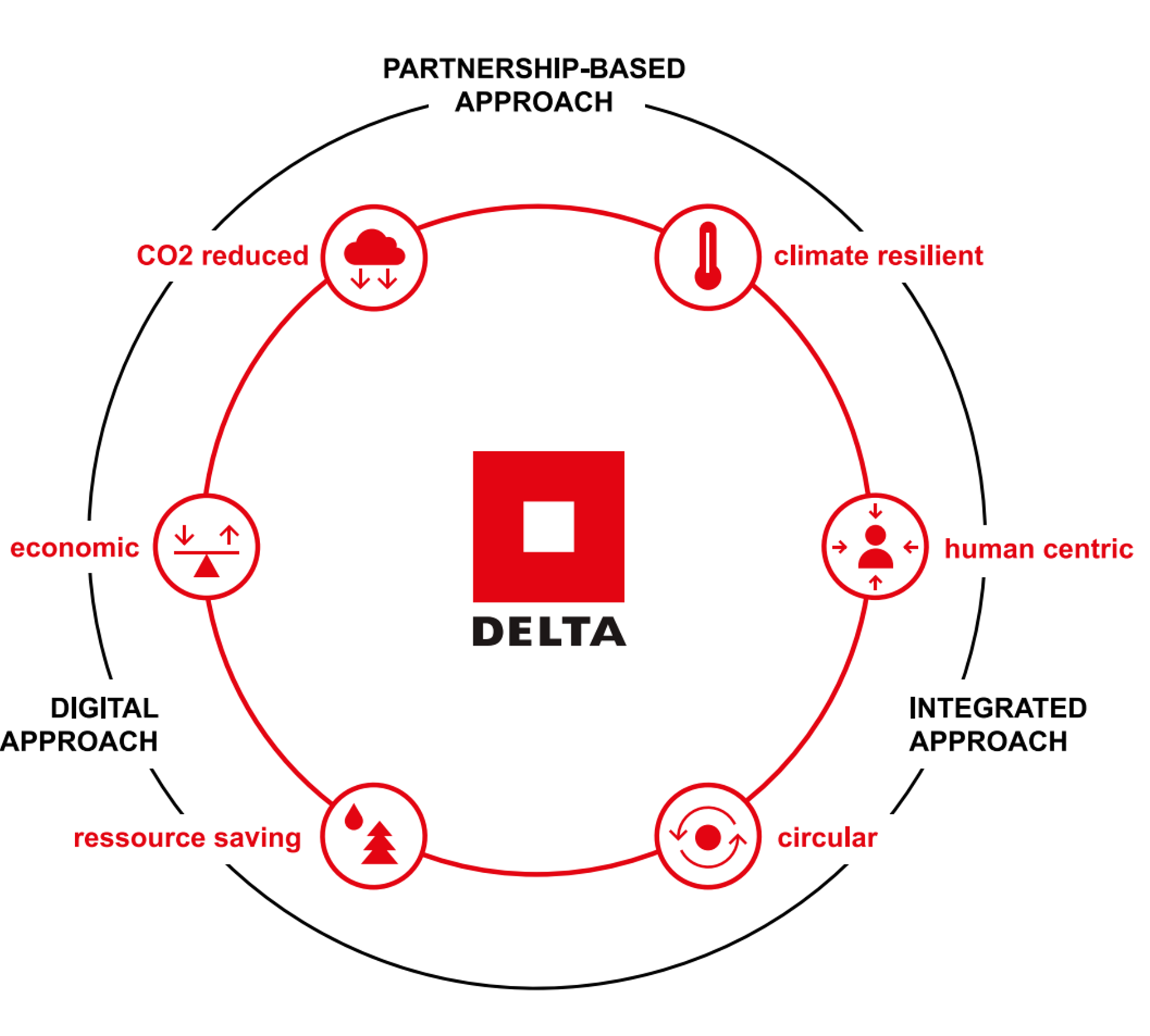
How can buildings be designed, renovated and further developed in a way that keeps materials in circulation for as long as possible? The circular economy is becoming an increasingly important topic for the construction and real estate industry. DELTA supports this transformation with an integrated approach that brings together existing buildings, planning, sustainability and digital methods.
The construction industry is transitioning from a linear economic model towards a more circular economy. The goal is to use existing buildings for as long as possible, conserve resources, reuse materials and use recyclable building materials, while already considering during the planning stage how a building can be adapted to changing needs in the future with as little destructive intervention as possible.
The construction industry is not yet fully circular. Achieving this requires the interaction of many stakeholders as well as suitable economic, technical and regulatory frameworks. At the same time, there are already numerous opportunities to implement circular economy principles in concrete construction and real estate projects.
Circular economy starts with existing buildings
One fundamental principle is that the circular economy does not begin with new construction. Preserving, renovating, revitalizing and repurposing existing buildings can make a significant contribution.
The first step is to understand which materials and components are present, how they were installed and what condition they are in. This is often a challenge, particularly with older buildings: existing plans may be outdated or may not document in sufficient detail how structures were actually built.
Digital surveys of existing buildings, non-destructive analysis methods and, increasingly, artificial intelligence are opening up new possibilities in this area. DELTA is also involved in research projects exploring how existing buildings and the resources they contain can be better documented, assessed and made available for future planning decisions.
Knowing what is inside a building
Data on materials and products provides an essential foundation for circular construction. Only when we know what has been installed in a building can its potential for reuse and recycling be reliably assessed.
Tools such as building resource passports provide a structured data basis for this purpose. Life cycle assessments also play an important role, making it possible, for example, to evaluate a building’s CO₂ emissions over its entire life cycle.
Building certifications already incorporate numerous aspects of the circular economy and support the systematic documentation of material information, building assemblies and relevant performance indicators.
Considering deconstruction from the planning stage
Circularity is not only about selecting sustainable building materials. How a building is constructed is equally important.
Can building components be separated again at a later stage? Are structures accessible? Can materials be reused or recycled using existing technologies?
These questions should be addressed as early as possible in the planning process. Deconstruction concepts are therefore increasingly being developed during the planning stage. The aim is not to anticipate the demolition of a new building, but to enable long-term adaptability.
The topic is also becoming increasingly important in tendering processes. Options for non-destructive deconstruction as well as the reuse and continued use of products and building components can already be assessed and taken into account from an economic perspective.
Regulatory frameworks continue to evolve
In Austria, the regulatory framework includes, among others, the Recycled Construction Materials Ordinance (Recycling-Baustoffverordnung), the Waste Management Act (Abfallwirtschaftsgesetz), the Landfill Ordinance (Deponieverordnung) and the OIB Guidelines.
Further requirements concerning the reusability and recyclability of buildings are expected. At European level, the availability of product and material information is also becoming increasingly important. This increases the importance of a structured data basis for planning, operation, adaptation and future deconstruction.
What does circular construction cost?
There is no general answer to this question. Economic viability depends greatly on the specific measures being implemented.
Digital methods for documenting and assessing buildings and materials can already be used economically and, in some cases, can make processes more efficient. By contrast, the removal, processing, storage and reinstallation of used building components may currently still involve higher costs.
For DELTA, however, this does not mean waiting for perfect conditions. Instead, the focus is on implementing measures that are already practical and economically viable today, gaining experience and gradually integrating circular economy principles more strongly into planning and project delivery.
Circular economy requires an integrated approach
The circular transformation involves more than individual materials or planning stages. DELTA combines Architecture, Building Construction Management and Consulting throughout the entire life cycle of a property.
From existing building analysis and revitalization to life cycle assessment, sustainable planning and building certification, as well as digital methods and deconstruction concepts, different areas of expertise can be brought together. In this way, the circular economy evolves from an abstract sustainability objective into a concrete component in the development of future-proof buildings.